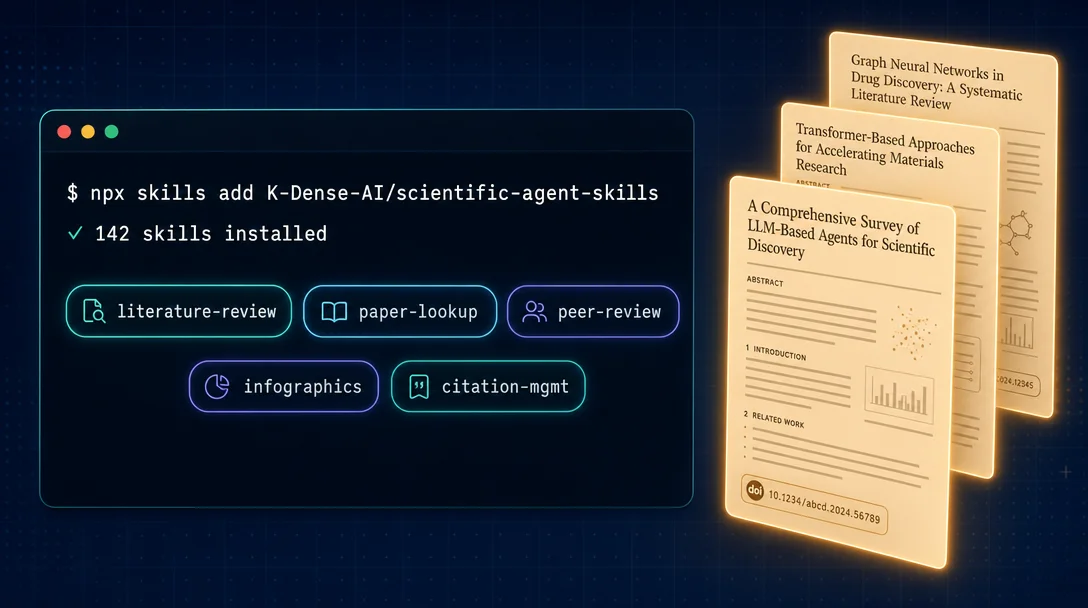
142 scientific agent skills, one command away
`K-Dense-AI/scientific-agent-skills` bundles 142 MIT-licensed scientific skills (v2.45.0, 26.8K stars) for Claude Code, Cursor, Codex, Gemini CLI, and Antigravity into a single `npx` command. The article covers the four highest-value skills for AI engineers (Literature Review with a 7-stage PRISMA pipeline, Paper Lookup across 10 academic databases, Infographics with AI quality-scoring iteration, and Peer Review with statistical rigor checks), the complete install walkthrough, three copy-paste usage examples, and an honest caveats section covering the unverifiable "160,000+ scientists" claim, the open Trivy security bug (Issue #162), zero community feedback due to the repo being only 3–4 days old, and the absence of any quantitative benchmarks across all 142 skills.

研究速览
K-Dense-AI/scientific-agent-skills — 26.8K stars, MIT-licensed, v2.45.0 — bundles 142 ready-to-invoke scientific skills across 18 categories into a single npx install. 1What it does
Install
uv package manager, and any Agent Skills-compatible agent client (macOS, Linux, or Windows with WSL2).uv if you don't have it:curl -LsSf https://astral.sh/uv/install.sh | shnpx skills add K-Dense-AI/scientific-agent-skills# install everything
gh skill install K-Dense-AI/scientific-agent-skills
# or pin a specific version
gh skill install K-Dense-AI/scientific-agent-skills --pin v2.45.0
# install only the skills you need
gh skill install K-Dense-AI/scientific-agent-skills --skill literature-reviewK-Dense Inc. explicitly warns: "Do not install everything at once. Only install the skills you actually need for your work." 8 Each skill can pull in its own Python dependencies; installing all 142 at once significantly increases setup time and token overhead.
Usage examples
Use the literature-review skill to review papers on
transformer-based protein structure prediction published
2022–2025. Output a PRISMA-compliant PDF with Nature citation style.Use paper-lookup to find all 2024 papers on GLP-1 receptor
agonists in Type 2 diabetes. Cross-reference PubMed and
OpenAlex, then pull open-access PDFs via Unpaywall.python skills/infographics/scripts/generate_infographic.py \
"5 benefits of exercise" \
-o figures/exercise.png \
--type list \
--style healthcare \
--research--research flag triggers Perplexity Sonar to gather current data before rendering. 5Community signals and known caveats
- The "160,000+ scientists" claim is unverifiable. Every search result for that figure traces back to the README itself — no independent source corroborates it. 2
- Issue triage is unstructured. Five open issues as of June 1, none with labels, milestones, or project assignments. Four of them have zero maintainer responses. 11
- A CI security bug is open and unacknowledged. Issue #162 reports that the Trivy security scanner returns exit code 0 even when vulnerabilities exist — a logic flaw in the scan script that can silently miss security findings. 12
- No quantitative benchmarks anywhere. None of the 142 SKILL.md files include before/after performance data. The only timing comparison available is K-Dense's own marketing copy: same drug-repurposing task takes 4–8 hours with the open-source skills vs. ~15 minutes with their paid K-Dense Web platform. 13 That comparison is useful context but comes from the vendor, not an independent test.
- Token overhead can be significant. AcademicForge, a project that imports this library as a dependency, notes that individual skill files run ~420 lines of SKILL.md plus ~300KB of reference material each. Token costs at scale are real.
When NOT to use this
- You need a fully autonomous pipeline. The open-source skills require you to orchestrate every step — K-Dense's own positioning is "you are the orchestration layer." 13 For end-to-end autonomous execution, their paid K-Dense Web tier (multi-agent, cloud GPU, 200+ skills including 60 exclusive ones) is what they actually built for that use case.
- Your domain is outside natural and exact sciences. The library is explicitly weighted toward biology, chemistry, and physics. A GitHub issue requesting social science and musicology support has been open since April with only one assignee and four comments. 11
- You need production-hardened security. The open Trivy false-negative issue means the CI security scan may not catch vulnerabilities. For security-sensitive workflows, verify independently.
- You want community-vetted quality across all 142 skills. Maintenance quality varies. The top-5 most-installed skills (scientific-writing: 608 installs, scientific-critical-thinking: 589, scientific-visualization: 588, scientific-brainstorming: 585, literature-review: 572) 15 have had the most real-world exposure. Skills deeper in the catalog — particularly the specialty categories like proteomics or neuroscience — have had far fewer users, and the lack of GitHub issue feedback means quality gaps may not surface until you run them.
参考来源
- 1K-Dense-AI/scientific-agent-skills — GitHub
- 2Scientific Agent Skills — AgentConn directory
- 3Literature Review SKILL.md — K-Dense-AI
- 4Paper Lookup SKILL.md — K-Dense-AI
- 5Infographics SKILL.md — K-Dense-AI
- 6Peer Review SKILL.md — K-Dense-AI
- 7Exa Joins the Scientific Agent Skills Library — K-Dense blog
- 8Scientific Agent Skills README.md — K-Dense-AI
- 9Beyond Prompting: Using Agent Skills in Data Science — Towards Data Science
- 10Reddit r/ClaudeCode — posts search
- 11Issues · K-Dense-AI/scientific-agent-skills — GitHub
- 12Issue #162: Trivy scan false negative — GitHub
- 13K-Dense Web vs Scientific Agent Skills — K-Dense blog
- 14Sreya Vangara on X
- 15K-Dense-AI/scientific-agent-skills — skills.sh registry
围绕这条内容继续补充观点或上下文。